Locative Case – Kalma Durumu (Bulunma Durumu) answers the questions: nerede? – where? kimde? – who has it? / with whom? nede? – in what? / on what? ne zaman? – when? (saat) kaçta? – at what time?
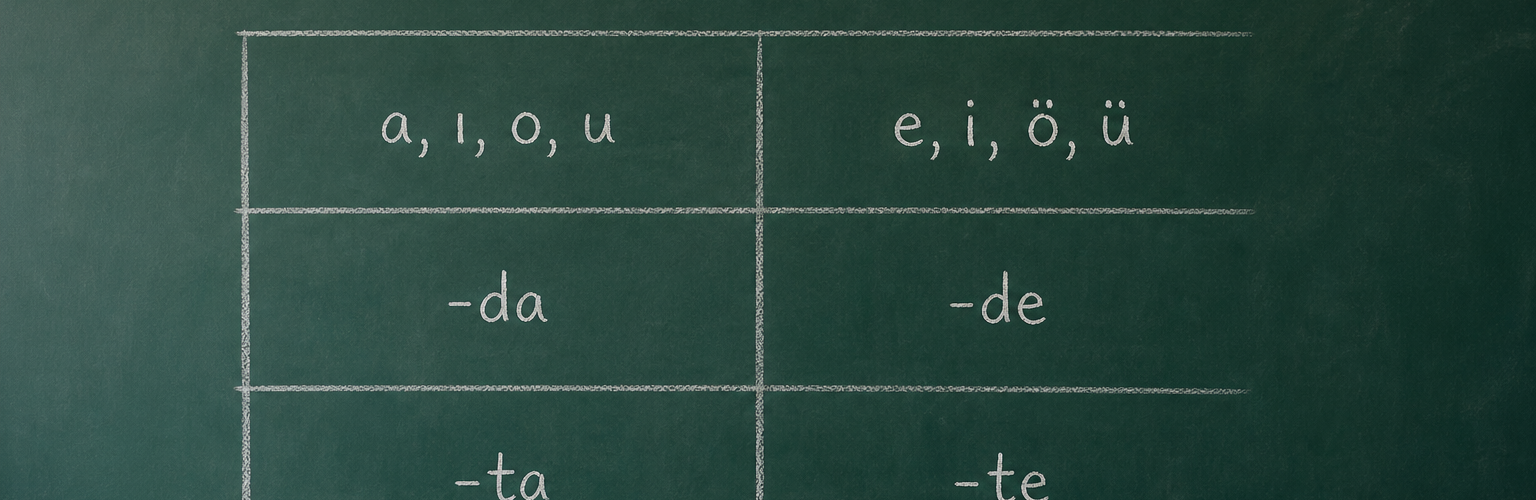
To form the locative case, the suffix – da, – de, – ta, – te is added to the noun according to vowel harmony.
| a, ı, o, u | e, i, ö, ü | |
| stem ends in a vowel or voiced consonant | -da | -de |
| stem ends in a voiceless consonant | -ta | -te |
Ben üniversitede okuyorum. I study at university
Annem şimdi evde. My mom is at home now
Çantada para var mı? Is there money in the bag?
Biz Türkiye’de oturuyoruz. We live in Turkey
When adding the locative suffix to proper nouns, an apostrophe is used before -da/de.
- İstanbul’da — in Istanbul
- Ankara’da — in Ankara
- Paris’te — in Paris
- Ali’de — with Ali
- Ayşe’de — with Ayşe
- Mehmet’te — with Mehmet
- Türkiye’de — in Turkey
- Ukrayna’da — in Ukraine
- Taksim’de — in Taksim
- Sultanahmet’te — in Sultanahmet
Personal Pronouns in the Locative Case
Bende – with me / I have | Bizde – with us / we have |
Sende – with you | Sizde – with you (plural/formal) |
Onda – with him/her | Onlarda – with them |
Çanta nerede? — Çanta evde. Where is the bag? — The bag is at home.
Telefon kimde? — Telefon bende. Who has the phone? — I have the phone.
Anahtar sende mi? — Evet, bende. Do you have the key? — Yes, I have it.
Kitap onda mı? — Hayır, onda değil, bizde. Does he/she have the book? — No, not him/her, we have it.
Kedi nerede? — Kedi bahçede. Where is the cat? — The cat is in the garden.
Para kimde? — Para sizde. Who has the money? — You have it.
Defter sende mi? — Hayır, sende değil, onda. Do you have the notebook? — No, not me, he/she has it.
Discover more from Turkish language
Subscribe to get the latest posts sent to your email.